
Existing Equipment: Actual capacity, condition, remaining value
Precision Equipment Replacement with Zero Disruption to Your Operations
Commercial Retrofits & Upgrades
Replacing commercial HVAC equipment isn't a weekend project. It's a coordinated operation involving crane logistics, roof penetrations, electrical modifications, controls integration, and air balancing—all while your tenants continue working below.
The difference between a retrofit that extends your building's operational life and one that creates years of callbacks is engineering discipline: proper load calculations for the actual current usage, custom curb adapters that seal correctly, air balancing that verifies performance, and coastal protection that addresses Baytown's corrosive environment.
Service Line executes commercial retrofits as construction projects, not emergency repairs. We plan the logistics, coordinate the trades, protect your tenants from disruption, and commission systems to verified performance standards.
RETROFIT VS. EMERGENCY REPLACEMENT
Asset Protection, Not Crisis Response
There are two ways to replace commercial HVAC equipment:
The Emergency Approach:
Equipment fails on the hottest day of summer. Tenants are complaining. You need cooling now. The contractor shows up with whatever equipment they can get quickly, drops it on the existing curb, connects it, and leaves. Three months later, complaints about hot spots. Six months later, the new compressor fails. Eighteen months later, you’re replacing it again.
The Retrofit Approach:
You recognize that 18-year-old equipment is approaching end-of-life. You plan replacement during shoulder season when partial outages are tolerable. Engineering analysis determines actual current loads (not the loads from 1998 when the building was built). Custom curb adapters ensure proper sealing. Air balancing verifies every zone receives design airflow. Coastal coatings protect against Baytown’s corrosive atmosphere.
The "Drop and Go" Problem
What Gets Skipped:
Curb Compatibility: New equipment rarely matches old curb dimensions exactly. Standard adapters leave gaps. Gaps leak air. Conditioned air escapes into the atmosphere. Unconditioned air infiltrates the building. Energy bills spike. The “new” system underperforms from day one.
Airflow Verification: The new unit has different fan characteristics than the old one. Static pressure changes. Airflow distribution shifts. Without balancing, some zones get too much air (cold complaints) while others starve (hot complaints). The building manager fields calls. The contractor is long gone.
Static Pressure Matching: A new, more efficient unit installed on old, restrictive ductwork operates against excessive static pressure. The blower motor works harder than designed. Amp draw increases. Motor life shortens. The “15-year” equipment fails in 7-8 years.
The Rush Job Reality
A facility manager calls for emergency RTU replacement. Low bidder promises installation by Friday. Unit gets dropped, duct gets connected, power gets turned on. Monday morning: half the building is 78°F. The new unit is running constantly. The invoice is paid. The "solution" becomes a new problem. We get the call six months later to diagnose why the new unit "doesn't work right."
How We Plan and Execute Commercial Equipment Replacement
A proper retrofit starts long before the crane arrives. We assess the existing installation, design the replacement approach, coordinate logistics, and plan for commissioning—all before the first piece of equipment moves.
Phase 1: Assessment
Before quoting, we evaluate:
Phase 2: Engineering
Based on assessment, we design the retrofit:
Phase 3: Logistics Coordination
Commercial equipment replacement requires coordination:
Phase 4: Execution
The installation itself follows our standard protocols:
Phase 5: Commissioning & Verification
A retrofit isn’t complete when the unit runs—it’s complete when the unit runs correctly. We verify performance before signing off.
Load Calculation for Retrofits
Buildings change. A 20-year-old RTU was sized for the original occupancy and use. Today's building might have different tenants, different equipment loads, different window films, or different insulation. We calculate current loads—not assume "same tonnage" is correct. Right-sizing the replacement often reduces capacity (and cost) while improving performance.
Our Crane Lift Protocol
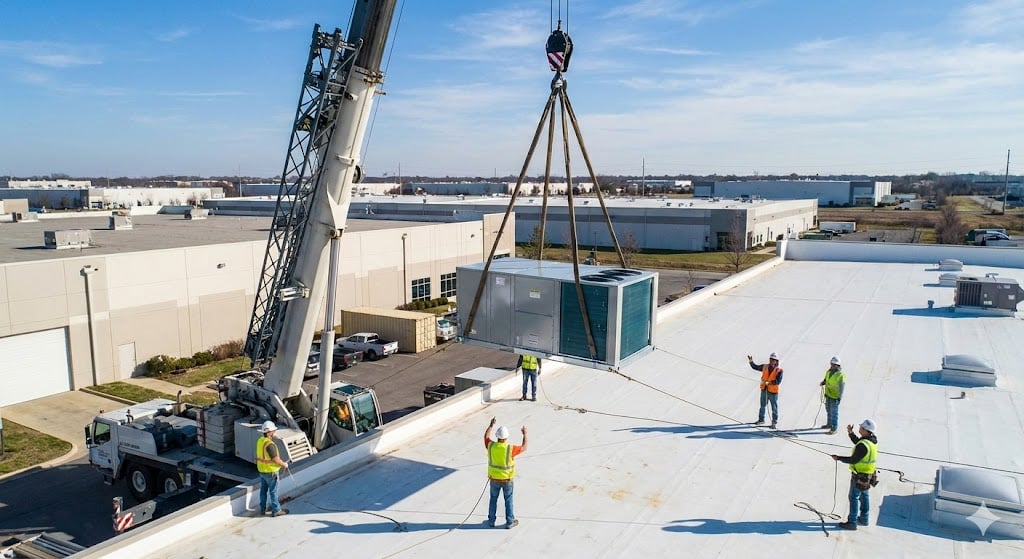
The Critical Connection: Custom Curb Adapters
The curb adapter is where new equipment meets existing building infrastructure. Get it wrong, and you've created a permanent air leak at the most critical connection point in the system.
Why Standard Adapters Fail:
Manufacturers make "universal" adapters designed to work with common curb sizes. Your curb isn't common—it's the specific size installed when the building was built, possibly modified over decades of equipment changes. Universal adapter + non-universal curb = gaps. Gaps get filled with foam, caulk, and tape. These materials fail in Texas heat within 2-3 years. Air leaks resume.
Our Solution: Smooth Transitions and Radius Elbows
Fabrication Advantage
Because we fabricate in-house, custom curb adapters don't delay the project. We measure, fabricate, and install—often within the same week. No waiting on third-party fabricators. No compromise on fit. The seal is permanent. The roof doesn't leak.
Sizing for Today's Building, Not 1998's
Commercial buildings change. The office building designed for 100 occupants working 9-5 might now house 150 people working varied schedules. The retail space designed for clothing racks might now be a restaurant. The warehouse that stored boxes might now include manufacturing processes.
Why Original Sizing May Be Wrong:
The "Same Size" Mistake:
The fastest retrofit approach: measure the old equipment nameplate, order the same tonnage in new equipment. Fast. Easy. Often wrong. If the building's loads have changed since original installation, "same size" perpetuates whatever problems existed—or creates new ones.

Our Load Analysis Process
Before specifying equipment, we analyze: current occupancy and schedules, internal heat sources (equipment, lighting, processes), envelope conditions (windows, insulation, infiltration), zone requirements (which areas need individual control), and ventilation requirements (current code may differ from original). The result: equipment sized for what your building actually needs today, not what it needed when originally constructed.
Verified Performance, Not Assumed Performance
Installing new equipment is the beginning, not the end. Until the system is balanced and commissioned, you don't actually know if it performs correctly.
What Air Balancing Verifies:
Supply Air Distribution: Does each zone receive design CFM? Does the corner office get the same conditioning as the open floor plan? Does the conference room that’s always complained about actually receive adequate airflow now?
Return Air Adequacy: Is return air volume sufficient for the supply being delivered? Is the building under positive or negative pressure? Are there pressure differentials between zones that affect door operation?
Temperature Performance: Does the system achieve design temperature differential (Delta-T) across the coil? Is conditioned air actually reaching occupied spaces at expected temperatures?

The "Hot Spot" Callback
The retrofit is complete. New equipment is running. Tenant in the southeast corner calls: still too hot. Investigation reveals the supply damper serving that zone was never adjusted from the temporary position used during installation. Air balancing catches these issues before the first tenant complaint—not six months later.
Technical Proof Points: Why Each Step Matters
Technical Why
Benefit to Client
Your Business Continues While We Work
Commercial HVAC retrofits happen in occupied buildings. Tenants have expectations: they can work, they can access their space, and they're not subjected to excessive noise, dust, or temperature swings.
Sources of Disruption
Our Disruption Management Approach
Schedule Optimization: Heavy operations scheduled for minimum-impact times: early morning, evenings, weekends when possible. Coordination with building management on tenant schedules.
Communication: Advance notice to building management with specific timelines. Updates when schedules change. Point of contact for tenant concerns.
Temporary Conditioning: For extended outages, temporary cooling solutions to maintain occupancy. Not always necessary, but planned for when required.
Containment: Dust barriers, floor protection, and HVAC isolation to prevent construction debris from entering occupied spaces.
Critical Facility Considerations
Some spaces can’t tolerate any HVAC interruption—server rooms, medical facilities, manufacturing processes. For these situations:
The Tenant Experience
Our goal: tenants know the HVAC was replaced because it works better—not because they suffered through the process. Minimal noise during business hours. No unexpected outages. Clean work areas. Professional crews who respect occupied spaces.
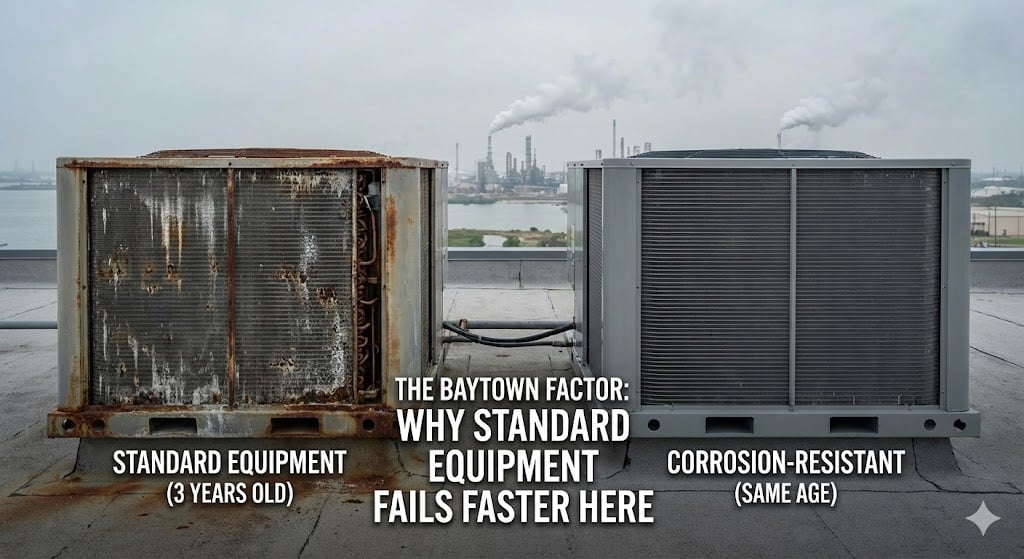
The Baytown Factor: Why Standard Equipment Fails Faster Here
Equipment in coastal/industrial environments like Baytown experiences corrosion at rates 30-50% faster than equipment in typical suburban locations. A condenser coil rated for 15 years might fail in 8-10 years without protection.
Our Coastal Protection Specification:
Coil Coatings: Factory-applied or field-applied protective coatings on condenser and evaporator coils. Options include epoxy coatings for moderate exposure, phenolic coatings for severe industrial environments, and hydrophilic coatings that combine corrosion protection with enhanced heat transfer.
Cabinet Protection: Upgraded cabinet materials or coatings for equipment exposed to direct weather. Standard painted steel cabinets fail quickly in coastal environments.
Electrical Protection: Corrosion-resistant connections, sealed control enclosures, and upgraded contact materials for components exposed to corrosive atmosphere.
Maintenance Protocol: Quarterly coil cleaning with appropriate chemicals removes accumulated deposits before they penetrate protective coatings.
The Baytown Equipment Life Reality
Standard equipment installed in Baytown without coastal protection: 8-12 year coil life typical. Same equipment with proper coatings and material selection: 15-18+ years. The upfront investment in protection pays for itself many times over in avoided replacement and downtime costs.
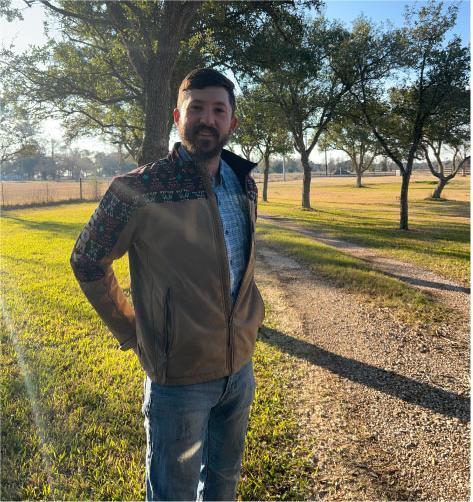
Meet Your HVAC Engineer
Michael Jarrell — Owner & Lead Engineer
Michael is a 2nd generation HVAC professional who started working alongside his father at age 12 in Southwest Louisiana. After graduating from Sowela Technical Community College, he earned his Industrial Electrician Certificate—a credential most HVAC technicians don't pursue—which allows Service Line to diagnose complex commercial systems, server room cooling failures, and electrical issues that other contractors have to refer out.
Michael moved to Baytown in 2015 and founded Service Line Air & Heat in 2022 with one mission: bring construction-grade precision to residential and commercial HVAC. When you call Service Line, you're not getting a parts-swapper—you're getting an engineer who measures before he recommends.
Michael moved to Baytown in 2015 and founded Service Line Air & Heat in 2022 with one mission: bring construction-grade precision to residential and commercial HVAC. When you call Service Line, you're not getting a parts-swapper—you're getting an engineer who measures before he recommends.
Industrial Electrician CertificateA2L Refrigerant Certified EPA 608 Universal Texas State HVAC License
Read Michael's Full StoryAsked Questions
Q: How long does a commercial RTU replacement take?
Typical single-unit replacement: 1-2 days from old unit removal to new unit operational. Larger units (20+ tons), multiple units, or complex installations may require additional time. We provide specific timelines during the assessment phase.
Q: Do you handle crane coordination and permits?
Yes. We coordinate crane scheduling, street closure permits (if needed), and all logistics. This is included in our scope—not a surprise add-on.
Q: Can you work around business hours?
Yes. We schedule heavy operations (crane lifts, major demolition) during off-peak hours—early mornings, evenings, or weekends—to minimize disruption to tenants and operations.
Q: What is a curb adapter and why does it matter?
A curb adapter connects new equipment to the existing roof curb. Standard “universal” adapters create gaps that leak conditioned air. Our custom-fabricated adapters are measured and built to match your exact curb dimensions, eliminating air leakage and energy waste.
Q: How do you protect against Baytown's coastal corrosion?
We specify coil coatings (epoxy or phenolic), upgraded cabinet materials, corrosion-resistant electrical connections, and sealed control enclosures. Without protective coatings, equipment fails 30-50% faster than in less corrosive environments.
Q: How do you protect against Baytown's coastal corrosion?
We specify coil coatings (epoxy or phenolic), upgraded cabinet materials, corrosion-resistant electrical connections, and sealed control enclosures. Without protective coatings, equipment fails 30-50% faster than in less corrosive environments.
Q: How do you coordinate crane operations?
We handle complete logistics: crane company selection, permit acquisition, traffic control, weather monitoring, and scheduling. Operations are coordinated with building management for minimum tenant impact.
Q: Do I need to replace with the same tonnage equipment?
Not necessarily. Building usage changes, tenant improvements, window upgrades, and other modifications affect actual heating and cooling requirements. Proper sizing for current conditions often results in smaller, more efficient equipment.
Q: What documentation do we receive after the retrofit?
Complete package includes: equipment specifications and warranty information, commissioning report with performance data, air balancing report with zone measurements, as-built drawings if modifications were made, and maintenance recommendations.
Let's Plan Your Equipment Upgrade
Whether you're facing end-of-life equipment replacement, planning tenant improvements, or upgrading for efficiency, we're ready to assess your situation and provide a detailed proposal.
We'll evaluate your existing installation, identify potential issues, and explain our approach—including timeline, logistics, and investment.