
Home Gyms: Train year-round without heat stroke. Mini-splits maintain precise temperature even during high-intensity workouts.
Ductless Mini-Split Systems
Precision cooling for garages, additions, and master suites. No ducts required.
The Problem: When Central Air Isn’t Enough
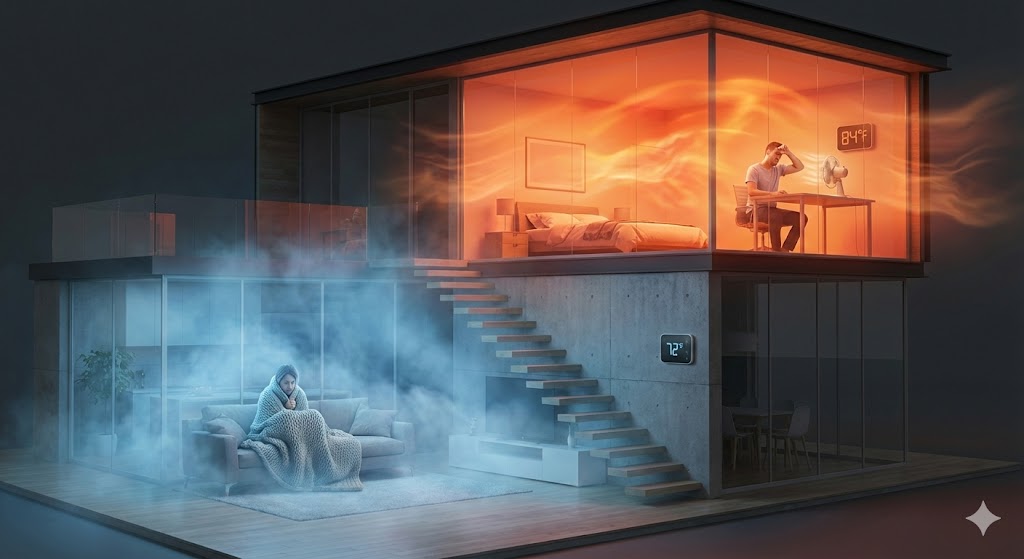
In Baytown and Mont Belvieu, many homes have a room that just never gets cool. Maybe it’s a bonus room over the garage, a sunroom, or a master bedroom at the end of a long duct run.
Extending your existing central ductwork is often a mistake. It ruins the static pressure of your main system, making the rest of the house hotter. More supply vents without a larger blower means less airflow everywhere.
The engineering solution is Decentralized Cooling.
The “Garage AC” Revolution
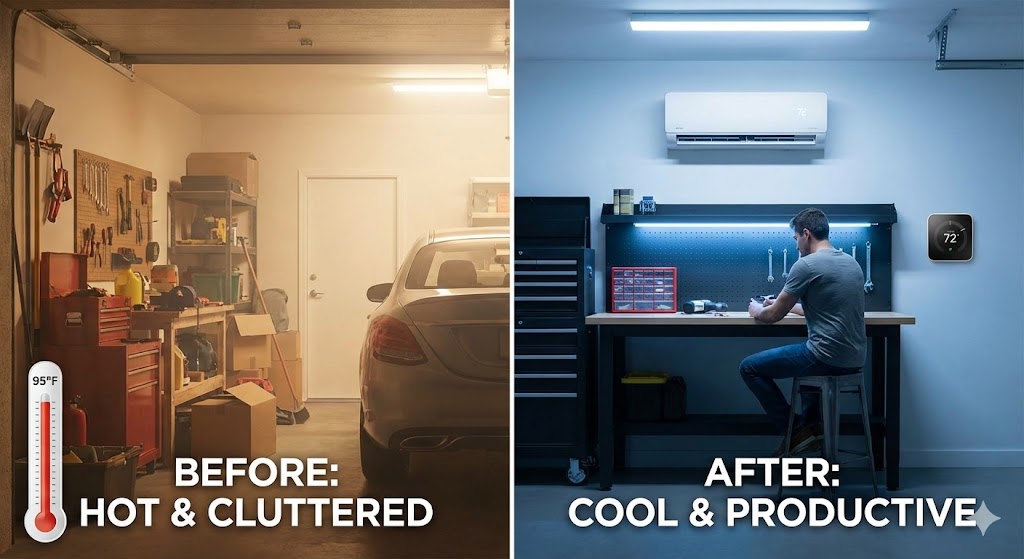
The most popular upgrade in Texas right now is the climate-controlled garage. Whether you have a home gym, a workshop, or just want to protect your vehicle from 100°F+ heat, a mini-split is the answer.
Common Garage Applications:
Construction Note: We Don’t Just Hang the Unit
We assess the thermal envelope of your garage. If your garage door is uninsulated, we calculate the heat gain to ensure the unit can keep up on August afternoons. An undersized unit will run 24/7 and never reach setpoint. We may recommend insulation upgrades to reduce the required tonnage and operating cost.
The Technology: Inverter-Driven Efficiency
Ductless systems are the most efficient HVAC equipment on the market, often exceeding 20 SEER2. Why? Inverter Technology.
How It Works:
Standard ACs blast full-speed, then shut off. It’s loud and inefficient. An inverter compressor speeds up and slows down based on real-time demand—like a car with cruise control instead of constantly slamming the gas and brake.
The Benefits:
Financial Benefit:
A 12,000 BTU mini-split in your garage costs $30-$50/month to operate vs. $80-$120/month for a window unit at the same cooling capacity.

Multi-Zone: Ultimate Comfort Control
Stop fighting over the thermostat. With a Multi-Zone Ductless system, one outdoor condenser can power up to five indoor heads, each with independent temperature control.
Example Configuration:
You only cool the rooms you’re using. Empty guest bedrooms don’t waste energy. This is the opposite of central air, which conditions the entire house whether you’re in it or not.
The Service Line Installation Standard
Ductless units are often installed poorly by “handymen,” leading to refrigerant leaks and premature failure. We install them with the same rigor as a 20-ton commercial chiller.
Precision Flaring
The #1 cause of mini-split failure is a leaking flare connection. Most installers use cheap flaring tools that create uneven seals. We use eccentric cone flaring tools and digital torque wrenches to tighten connections to the exact manufacturer specification. No guessing.
Why It Matters: A micro-leak loses 5-10% of refrigerant per year. After 3 years, the system is starved, overheating the compressor. Proper flaring prevents this $1,500+ repair.
Nitrogen Pressure Test
We pressurize the refrigerant lines to 600 PSI with dry nitrogen to guarantee there are no micro-leaks before we release refrigerant. This is the same procedure used in commercial refrigeration—but most residential installers skip it to save 30 minutes.
Why It Matters: Finding a leak before charging is free. Finding it after means recovering refrigerant ($150+), repairing, and recharging. We catch problems at zero cost.
Shielded Communication Wiring
One of the most common failure points for mini-splits installed by handymen is the communication wire. They often use standard thermostat wire, which causes communication errors between the indoor and outdoor units—resulting in “ghost” error codes and intermittent shutdowns.
Our Approach: We use shielded, stranded 14/4 cable specifically designed for inverter communications. The shielding prevents electromagnetic interference from nearby wiring, appliances, or industrial equipment—a real concern in Baytown’s petrochemical environment.
Why It Matters: Ghost error codes cause unnecessary service calls ($150+) and frustrated homeowners. Proper wiring eliminates communication failures from Day 1.
Gravity Draining
Mini-splits produce condensate (water) that must drain. The lazy approach is to install a mechanical condensate pump. These pumps are prone to failure, cause noise, and require maintenance.
Our Approach: Whenever possible, we design gravity-fed drain systems. We route the drain line with proper pitch to an exterior exit point or existing drain infrastructure. No pumps, no noise, no future failures.
Is Ductless Right for You?


Meet Your HVAC Engineer
Michael Jarrell — Owner & Lead Engineer
Michael is a 2nd generation HVAC professional who started working alongside his father at age 12 in Southwest Louisiana. After graduating from Sowela Technical Community College, he earned his Industrial Electrician Certificate—a credential most HVAC technicians don't pursue—which allows Service Line to diagnose complex commercial systems, server room cooling failures, and electrical issues that other contractors have to refer out.
Michael moved to Baytown in 2015 and founded Service Line Air & Heat in 2022 with one mission: bring construction-grade precision to residential and commercial HVAC. When you call Service Line, you're not getting a parts-swapper—you're getting an engineer who measures before he recommends.
Michael moved to Baytown in 2015 and founded Service Line Air & Heat in 2022 with one mission: bring construction-grade precision to residential and commercial HVAC. When you call Service Line, you're not getting a parts-swapper—you're getting an engineer who measures before he recommends.
Industrial Electrician CertificateA2L Refrigerant Certified EPA 608 Universal Texas State HVAC License
Read Michael's Full StoryAsked Questions
Can I air condition my garage in Texas?
Yes. A ductless mini-split is the ideal solution for garage cooling in Texas. Unlike extending central ducts (which ruins home airflow), a mini-split is an independent system that handles the high heat load of an uninsulated garage efficiently. We size the unit based on your garage’s square footage, insulation level, and whether you keep the door open frequently.
What is Inverter Technology?
Inverter technology allows the AC compressor to ramp up and down smoothly like a dimmer switch, rather than shutting on and off like a light switch. This maintains precise temperature (within 0.5°F), removes more humidity (critical in Mont Belvieu), and reduces electricity usage by 30-50%.
Do mini-splits work in the winter?
Yes. Modern mini-splits are heat pumps that can reverse operation to provide efficient heating. Our hyper-heat models can harvest heat from outdoor air even when temperatures drop near freezing—often more efficiently than electric strip heat, saving 30-40% on heating costs.
How long does installation take?
A single-zone garage installation typically takes 4-6 hours. This includes mounting the unit, running the lineset, performing a nitrogen pressure test, and vacuuming the system to 500 microns. Multi-zone systems (2-5 heads) take 1-2 days depending on complexity and line routing.
Cool Your Garage. The Right Way.
Don’t trust your mini-split to a handyman. Get precision installation from construction professionals.